Most colour and white-tunable LED strips get grouped under one umbrella — "RGB strips," "CCT strips" — as if they're interchangeable variants of the same product. They aren't. What actually separates them is the number of independently controlled LED channels running down the strip, and that number determines what the strip can and can't do once it's installed. Get the channel count wrong at specification stage and no amount of controller programming fixes it after the ceiling is closed.

What Each Channel Count Buys You

2CH
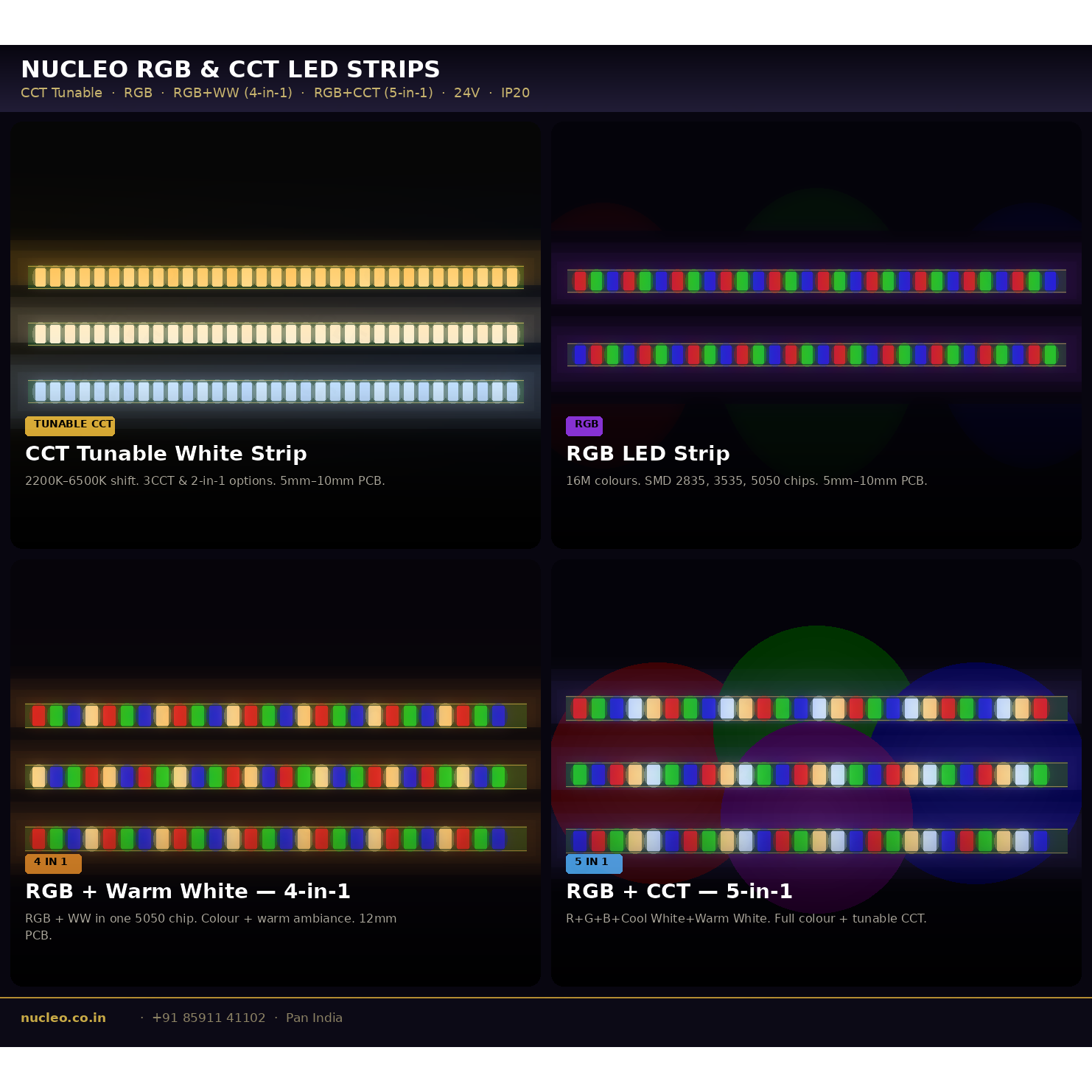
CCT Tunable White

Warm white and cool white as two independent channels, mixed to any point between 2200K and 6500K. No colour channels at all — every LED in the run is dedicated to producing the best possible white.

  • Highest CRI and white consistency in the range
  • Driven by a 2-channel controller or DALI DT8
  • Correct choice whenever colour is not required
3CH
RGB

Red, green and blue as three independent channels. Full colour mixing across roughly 16 million combinations, but white is produced by driving all three at once — never as clean as a dedicated white channel.

  • Correct where colour impact matters more than white quality
  • 3-channel controller, DMX, RF or app control
  • 5mm, 8mm and 10mm PCB options
4CH
RGB + WW

Adds one dedicated white LED — usually warm white — to the RGB chip. One strip now produces both colour and a fixed, reasonably clean white channel, without needing a second strip run.

  • Single run serves colour scenes and ambient white
  • 4-channel RGBW controller required
  • 12mm PCB, 5050 chip, up to 18W/m
5CH
RGB + CCT

Red, green, blue, cool white and warm white as five fully independent channels in one chip. Full colour mixing plus a genuinely tunable white — this is the only configuration where colour and white quality are both uncompromised.

  • Replaces a separate CCT run and RGB run with one strip
  • 5-channel controller or DALI DT8 with colour extension
  • 10mm & 12mm PCB, up to 24W/m

The most common specification error: ordering an RGB or RGB+WW strip for a space where white quality is the actual requirement — then discovering on site that the "white" setting looks flat and greenish next to the room's other light sources. If colour is a nice-to-have and white is the job, specify CCT or 5-in-1. Never rely on RGB-mixed white for a critical white application.

Colour Temperature Range

Applies to the CCT channels in both the 2-channel tunable strip and the white channels of the 5-channel RGB+CCT strip.

2200K
Candlelight
2700K
Luxury Warm
3000K
Hospitality
3500K
Retail
4000K
Office/Task
5000K
Gallery
6500K
Daylight

Specification Reference by Channel Count

All strips: 24V DC · IP20 · 24–26 lm/LED · CRI 80+

2-Channel — CCT Tunable White (IP20)
ChipLED/mPCBPower/mColour Config
2025-24V2405mm12W3CCT (WH+WW)
2835-24V1208mm12W2-in-1 dual white, continuous
2835-24V24010mm20W3CCT (WH+WW)
2835-24V24010mm15W2200K–4000K narrow-warm range
3-Channel — RGB (IP20)
ChipLED/mPCBPower/mOutput
2835-24V1205mm16.8WR · G · B
3535-24V1208mm18WR · G · B
5050-24V6010mm12WR · G · B
5050-24V12010mm12WR · G · B
4-Channel — RGB + WW (IP20)
ChipLED/mPCBPower/mOutput
5050-24V6012mm18WR · G · B · W (warm)
5050-24V12012mm12WR · G · B · WW
5050-24V6012mm18WR · G · B · WH (cool)
5-Channel — RGB + CCT (IP20)
ChipLED/mPCBPower/mOutput
3535-24V21610mm20WR · G · B · WH · WW
5050-24V6012mm18WR · G · B · WH · WW
5050-24V9612mm24WR · G · B · W · WW

Before ordering: confirm the controller's channel count and control protocol against the strip. A 2-channel CCT controller, 3-channel RGB controller, 4-channel RGBW controller and 5-channel RGBCCT controller are not interchangeable — a mismatch leaves channels dark or uncontrolled. Nucleo can confirm the correct controller pairing against the exact strip SKU before dispatch.


Specification Advantages

🎛️
Channel-First Architecture
Four channel counts cover every project requirement precisely — no strip is over-specified or under-delivering on what a room needs.
24V Across the Range
Constant 24V voltage on every channel configuration. Up to 10m per run without power injection for large-scale hospitality and commercial projects.
🌡️
2200K–6500K CCT Coverage
From candlelight warmth to daylight — the 2-channel and 5-channel strips share the same tunable white engine and CCT accuracy.
🔵
DALI DT8 Ready
CCT and 5-channel RGBCCT strips integrate directly with DALI DT8 drivers and BMS-controlled lighting infrastructure.
📐
5mm–12mm PCB Widths
Eight PCB widths across the four channel configurations, so profile selection isn't constrained by channel count.
🏅
CRI 80+, Bin-Matched
Every configuration holds CRI 80+ with colour binning across production runs — critical for long, visually continuous cove installations.

Project Applications by Channel Count

🏨
Hotel Corridors
2-channel CCT for consistent, high-CRI white cove lighting with day/night scene shift.
🛏️
Guest Rooms
5-channel RGB+CCT for bedside mood colour plus circadian white presets from one strip run.
🍸
Bar & Lounge
3-channel RGB for saturated colour behind the bar and on booth perimeters where colour impact leads.
🛍️
Flagship Retail
4-channel RGB+WW for window displays that need colour scenes plus a dependable warm white fallback.
🏠
Luxury Residential
2-channel CCT for living and bedroom coves. 5-channel for entertainment rooms and feature walls.
🏥
Healthcare
2-channel CCT for circadian protocols — cool white for procedure areas, warm for recovery rooms.
🍽️
Fine Dining
2200K–4000K narrow-range CCT strip so the room never drifts into a cool, clinical white tone.
🎭
Auditorium & Events
3-channel and 5-channel strips for stage wash, perimeter colour and DMX-driven scene transitions.

Technical Questions

How many channels does a colour LED strip actually need?
The channel count should be set by what the space needs to do, not by what looks most capable on a spec sheet. If a room only ever needs to shift between warm and cool white, a 2-channel CCT strip does that with better white quality than any strip carrying colour channels. If the space needs saturated colour scenes, 3-channel RGB is enough. Only specify 4 or 5 channels when the same run genuinely needs both a strong ambient white and full colour from one product.
What's the practical difference between 4-in-1 and 5-in-1 strips on site?
A 4-in-1 strip carries red, green, blue and one fixed white LED — usually warm white. A 5-in-1 strip carries red, green, blue, cool white and warm white as five fully independent channels, so the white output itself can be tuned across the CCT range in addition to full colour mixing. A 5-in-1 strip can replace what would otherwise be two separate installations — a CCT run and an RGB run — from a single cable and controller.
Can a CCT tunable strip later be swapped for RGB without rewiring?
No. CCT strips are wired for 2 channels, RGB for 3, and the driver, controller and cable core count are all matched to the channel count at install. Swapping strip type after the fact means replacing the strip, the controller and often re-pulling cable — get the channel architecture right at specification stage, before the profile is closed into the ceiling or wall.
Why does white look different between an RGB strip and a CCT strip?
RGB strips produce white by mixing red, green and blue at full output, which gives a white point but with weaker colour rendering and a visible tint on close inspection. CCT strips use dedicated warm and cool white LED chips, rendering skin tones and materials far more accurately and holding CRI 80+ consistently. Where white quality is the primary requirement, CCT or a 5-in-1 strip's dedicated white channels should always be specified over RGB-mixed white.
What controller do I need to match a 5-channel RGBCCT strip?
A dedicated 5-channel RGBCCT controller, or a DALI DT8 driver and controller configured for the full colour-plus-tunable-white control mode. A standard 3-channel RGB controller or 2-channel CCT controller will only drive part of the strip and leave the rest uncontrolled. Confirm channel count and control protocol — RF, Zigbee, DMX or DALI-2 — against the strip before ordering.
Is the 2200K–4000K tunable white strip different from a standard CCT strip?
Yes. Both use the same 2-channel warm/cool architecture, but the 2200K-4000K variant deliberately narrows the tuning range to stay within warm-to-neutral tones, excluding cooler 5000K+ whites. It is specified for bedrooms, dining rooms, spas and luxury hotel rooms where the light should never be able to shift into a clinical or daylight tone, even at its coolest setting.
Do 4-in-1 and 5-in-1 strips need thicker cabling than single-colour strips?
They need more cores, not necessarily thicker gauge. A CCT strip runs on a 3-core cable, RGB on 4-core, a 4-in-1 strip on 5-core, and a 5-in-1 RGBCCT strip on 6-core. Core count must match channel count exactly or individual channels will be left unconnected. Cable gauge itself is still set by run length and total wattage per channel, same as any LED strip run.