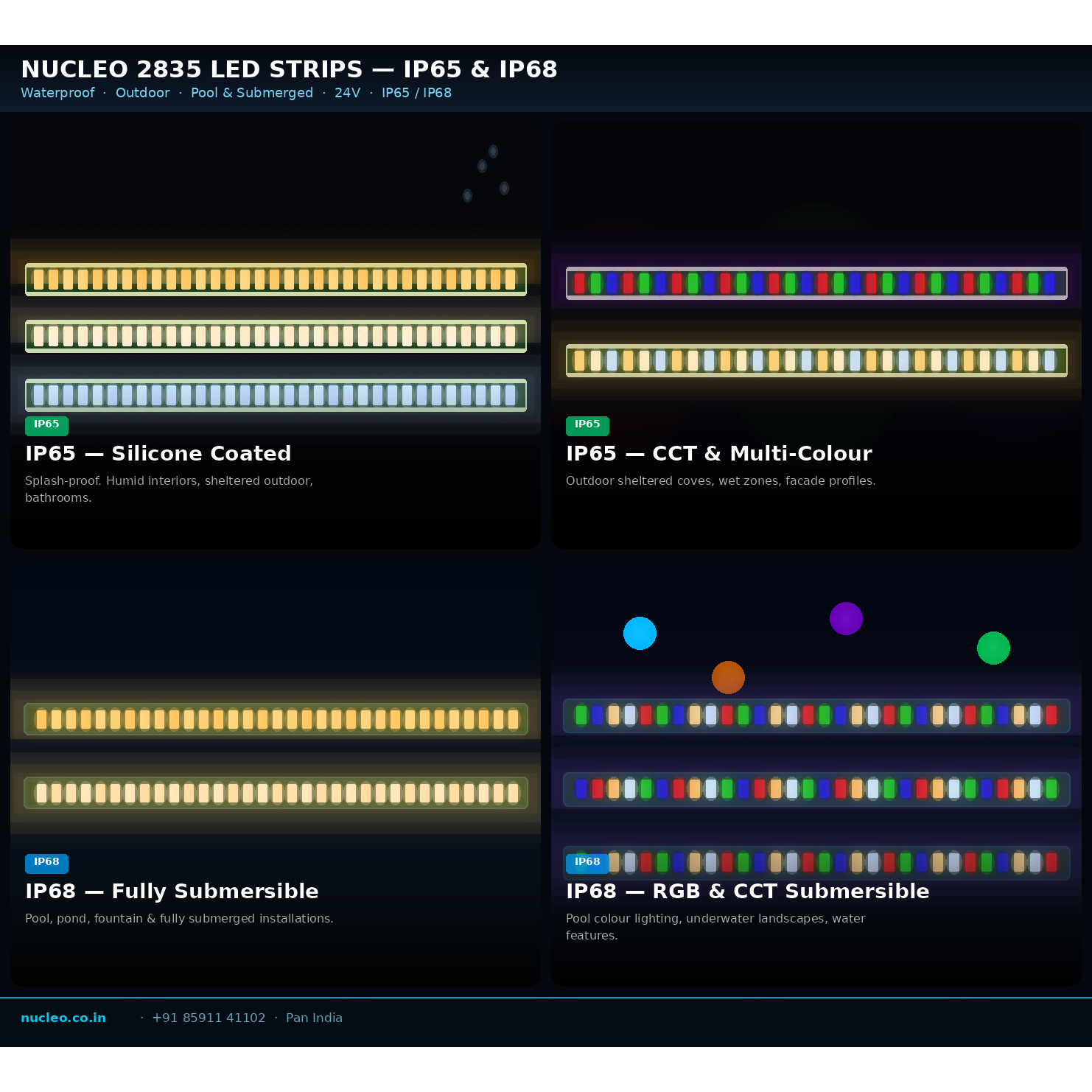
IP65 and IP68 aren't marketing tiers — they're a literal ingress protection code. The first digit rates dust protection, the second rates water. Both of these strips carry the same first digit; every practical difference in what they can survive comes down to the second one. Misreading that digit is how a strip ends up failing inside a sealed aluminium profile a year after handover, in a location nobody can get back into.
First Digit — Solids & Dust
6
Identical on both strips. Rating 6 means fully dust-tight — no ingress of dust under test conditions. This digit is not where IP65 and IP68 differ.
Second Digit — Water
5 or 8
5 — protected against low-pressure water jets from any direction (12.5 l/min, 3 minutes). 8 — rated for continuous submersion beyond 1 metre depth, duration set by the manufacturer. This is the digit that determines where each strip can go.
The mistake that shows up a year later: specifying IP65 for a run that turns out to sit in open rainfall, standing water after heavy rain, or irrigation overspray. IP65 holds up fine on day one — the failure is gradual, showing up as flickering or dead sections once water works past the coating over repeated exposure. If there's any doubt the location will stay sheltered for the life of the installation, specify IP68 instead.
24V SELV — the correct voltage for wet areas: every strip in this range runs at 24V DC, within the Safety Extra Low Voltage classification. Contact with the strip surface does not present a shock hazard under normal conditions. The requirement that doesn't go away: the driver must be installed outside the wet zone and must meet local electrical code for its location.
🔎
Second-Digit Clarity
Every product in the range is specified against its actual second-digit rating, not a generic "waterproof" label — 5 for splash, 8 for submersion.
🌧️
IP65 Silicone Coat
Conformal coating seals the PCB and chips against humidity, condensation, cleaning chemicals and directional water jets.
🏊
IP68 Full Encapsulation
Gel-tube or epoxy seal rated for continuous submersion — the only correct choice for pool, pond and fully exposed outdoor runs.
⚡
24V SELV Throughout
Safety Extra Low Voltage output across the entire waterproof range, correct for wet-area and pool-adjacent lighting.
🌈
White, CCT & RGB in IP68
The submersible range covers single white, 3CCT tunable and RGB+WW — full colour versatility, fully sealed.
📐
Standard Profile Fit
5mm to 12mm PCB widths retain compatibility with standard aluminium profile channels — no special extrusion needed for either rating.
🛁
Bathroom Coves
IP65 for mirror surrounds, shower niches and ceiling coves in humid wet rooms.
🏗️
Covered Facade
IP65 for sheltered building facades, covered walkways and under-eave cove lighting.
🍳
Outdoor Kitchen
IP65 for covered kitchen coves, BBQ areas and bar undershelves exposed to steam and splash.
🌿
Sheltered Landscape
IP65 for covered pergola lighting and planter coves with a rain-cover profile.
🏊
Swimming Pools
IP68 for pool wall perimeters, steps and underwater accent lines. RGB for colour wash.
🪷
Ponds & Fountains
IP68 submerged in ponds, ornamental features and illuminated fountain channels.
🌧️
Exposed Facade
IP68 for rain-exposed facades, open-air coves and roof-line runs with no housing.
🌱
Landscape Channels
IP68 in ground-level drainage channels, paving slots and garden paths exposed to rain.
What do the two digits in an IP rating actually mean?
The first digit rates protection against solid objects and dust, 0 to 6. The second rates protection against water, 0 to 9K. Both IP65 and IP68 strips carry a first digit of 6 — fully dust-tight — so the products are identical on dust protection. The entire practical difference sits in the second digit: 5 means protected against water jets from any direction, 8 means rated for continuous submersion beyond 1 metre depth.
Is IP65 enough for an outdoor installation, or should I always specify IP68?
IP65 is enough for locations sheltered from direct rain — under eaves, inside a closed profile, on a covered facade or under a pergola roof. It is not enough for any surface sitting in open rainfall, standing water, or irrigation spray. If there's doubt the installation will stay fully sheltered for its service life, specify IP68 — the cost difference is minor next to the cost of a failed strip inside a sealed profile.
Are IP68 LED strips actually safe near a swimming pool?
Yes, when specified correctly. These strips run at 24V DC SELV — low enough that contact with the strip surface does not present a shock hazard under normal conditions. What doesn't change: the driver must sit outside the wet zone, in a location meeting local electrical code for pool and wet-area equipment.
Does the sealing reduce brightness or increase heat buildup?
There's a small measurable effect, not a functional problem. The silicone coating on IP65 and the gel-fill or epoxy on IP68 act as a thin thermal barrier, so waterproof strips run marginally warmer than a bare IP20 strip at the same current, with a very slight light transmission loss. This doesn't change power or spacing calculations for standard runs, but very long, high-density submerged runs should be checked against maximum run length for heat dissipation.
Can an IP65 or IP68 strip be cut and re-terminated on site?
IP65 strips can be cut at marked points and resealed with waterproof connectors or silicone sealant and heat-shrink — the coating at the cut line must be manually restored. IP68 strips are stricter: the gel tube or epoxy is continuous, so cut ends need a proper IP68-rated end cap or potted connector, not just sealant. An improperly resealed cut end is the most common cause of waterproof strip failure on site.
What PCB widths and colour options are available?
IP65: 5mm, 8mm and 10mm PCB, in 2700K, 3000K and 4000K single-colour white. IP68 extends to 5mm, 8mm, 10mm and 12mm PCB, with the 12mm variant carrying 3CCT tunable white and RGB+WW. Both ratings share the same profile channel compatibility as the standard IP20 range.