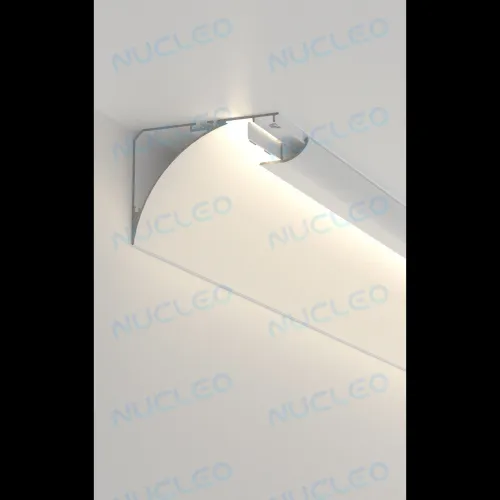
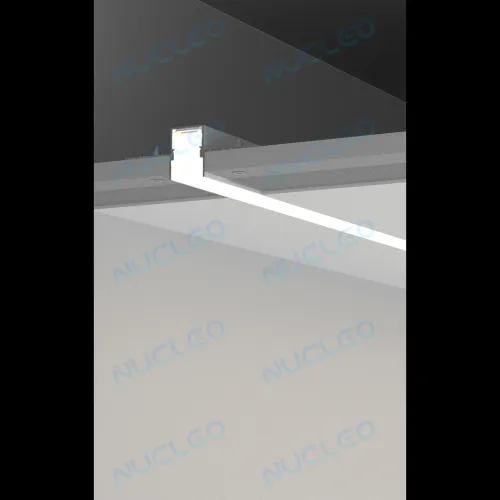
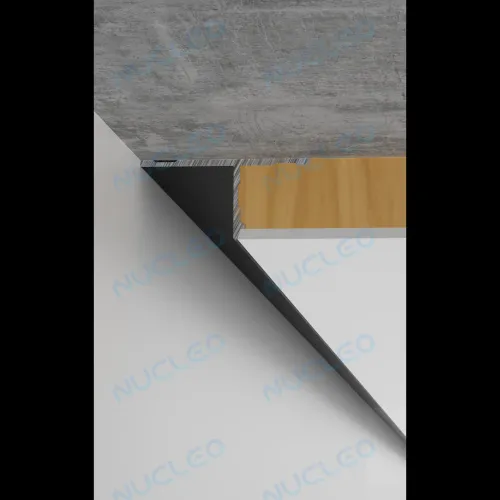
Replaces the skirting board
The aluminium section terminates the wall base with a sharp, modern edge instead of a painted timber skirting.
 Chat with us
Nucleo · Aluminium Profile
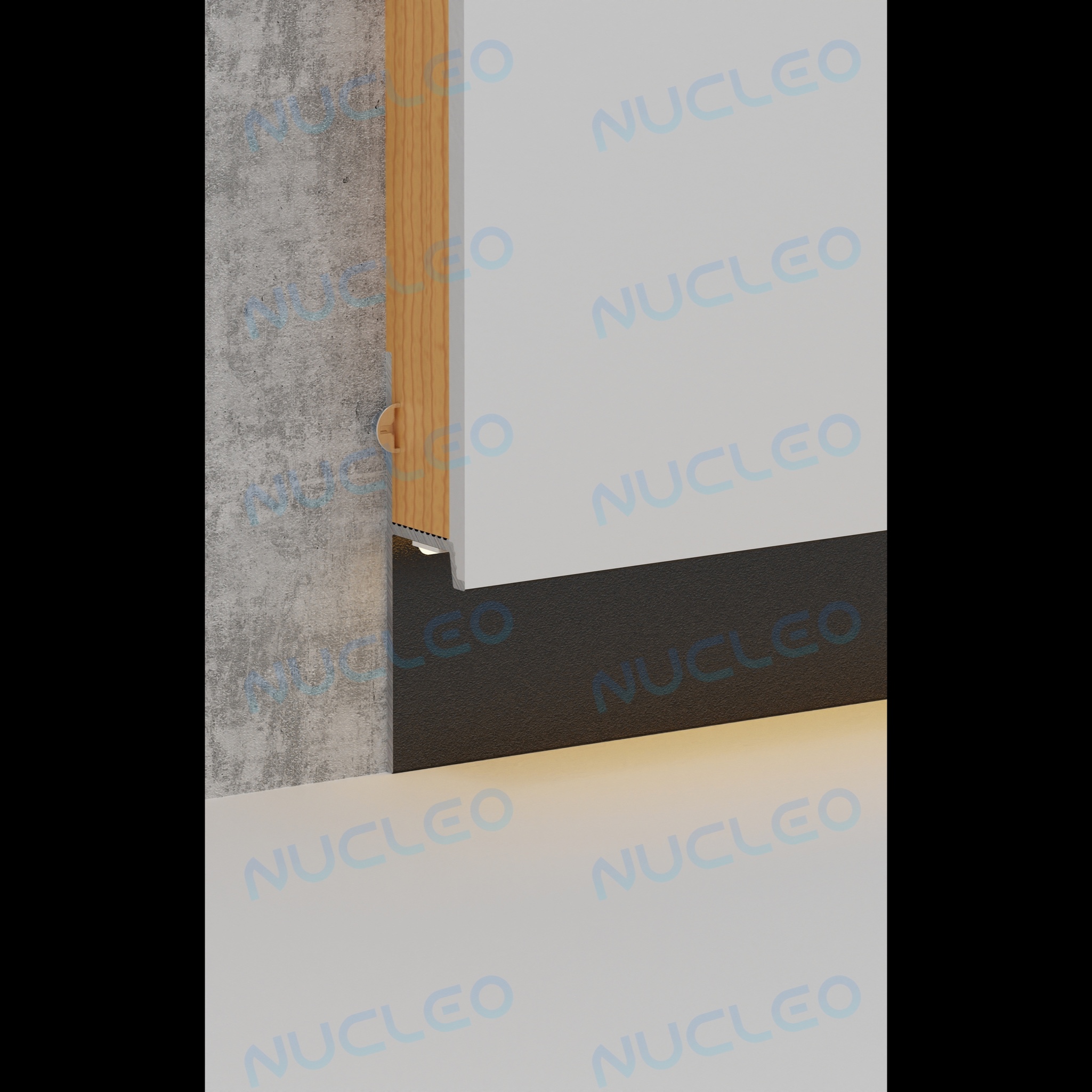
The NLP-XF17 is plastered into the wall base and replaces the skirting board. It leaves a crisp channel at floor level for an LED strip, so walls look like they float and floors are lit without glare.
Why it works
A conventional skirting board hides the joint between wall and floor. The NLP-XF17 turns that joint into a design feature. It is a T-shaped aluminium section, 13.7mm by 42mm, set into the wall base before plastering. The plaster finishes flush with the flange, leaving a straight, shallow recess where an LED strip sits.
Because the profile has no diffuser, the light lands as a defined line on the floor rather than a wash. That precision suits bedrooms, corridors and hospitality interiors where the lighting should guide, not announce itself.
Features
The aluminium section terminates the wall base with a sharp, modern edge instead of a painted timber skirting.
The wall appears to float above the floor, a detail architects use to make rooms feel taller and cleaner.
The flange is fixed before plastering and the finish runs flush to it, so the line stays straight and chip-free.
Shallow enough for standard plaster build-ups while wide enough to hold a clean, defined channel.
Ankle-height light guides movement without glare when you sit or lie down.
Resists mop and vacuum scuffs far better than painted plaster at the base of a wall.
The channel stays clean through plastering and painting; the LED strip goes in at the end.
Applications
A soft guide from bed to bathroom without a main light.
One continuous line along long, repeating wall runs.
Restful low-level ambience after dark.
Visual length in narrow passages.
Orientation at the top and bottom of steps.
Gentle floor-level light for night-time movement.
Walls that appear to float above the floor.
Safe movement with minimal screen interference.
Quiet wayfinding without harsh overhead light.
Defined wall bases that hold a low-light mood.
Installation
Fix the profile level and straight before plastering, since the line of light reveals any drift along the wall. Mitre corners and dry-fit them first. After plastering, clean the channel and fit a narrow, high-density strip in a warm tone. Keep driver access open for future servicing.
FAQ
Before the final plaster coat. Fix the T-flange at the wall base, bring the plaster flush to the flange edges, and keep the channel clean so the strip can be fitted afterwards.
No. It is an open channel, so the light falls as a defined edge rather than a soft wash. Strip choice and mounting depth shape the final look.
A narrow, high-density strip in a warm colour temperature gives the smoothest line. Dense chip spacing reduces visible dotting on the floor.
The aluminium tolerates normal cleaning, but the profile does not seal the strip. In wet-cleaned areas use a suitably rated strip and keep driver and joints away from standing water.
No. It is a rigid extrusion for straight runs. Corners are formed with mitred cuts.
Cut each length at 45 degrees for internal and external corners, dry-fit before fixing, and keep the strip continuous with a flexible joiner or solderless connector.
Use a fine-tooth metal blade and deburr the ends. Contact Nucleo for available lengths and finishes.
Share your drawings and Nucleo will help match the profile, strip and driver to your wall detail.