One Corner, Two Light Lines
Why the NLP-6969 exists — and what problem it solves at the wall-ceiling junction
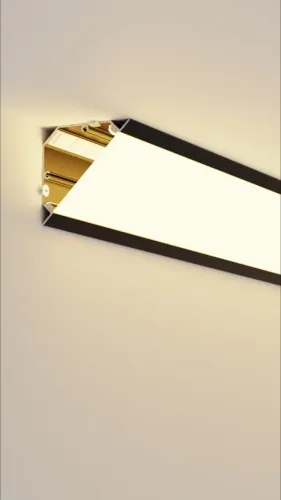
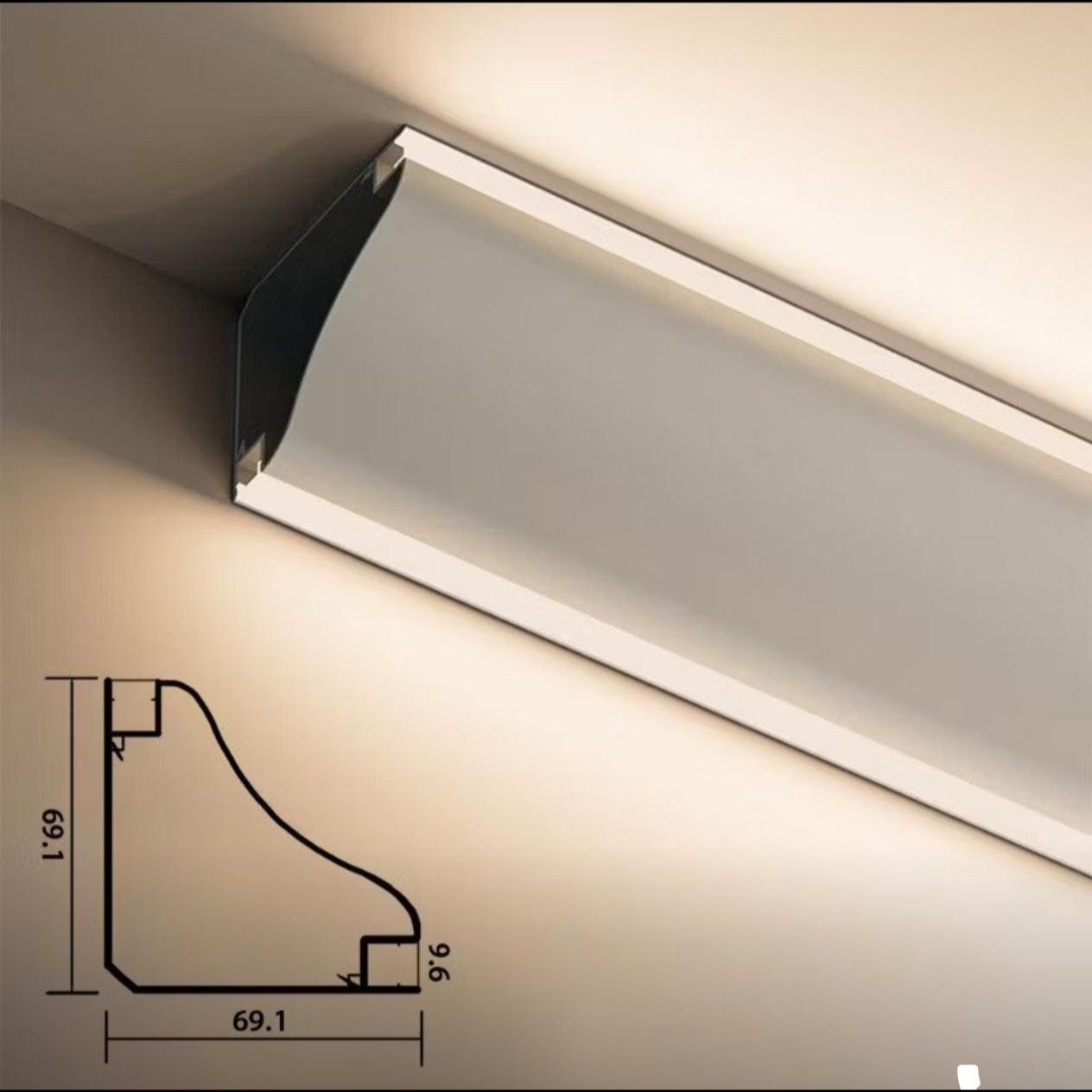
Every room has a hard 90° line where wall meets ceiling — and most lighting plans ignore it entirely, leaving it as a shadowed edge that flattens the space. The NLP-6969 turns that same corner into the light source. It's a 69x69mm aluminium extrusion built specifically for this junction, carrying two separate LED channels inside a single profile body — one aimed at the ceiling, one aimed at the wall — so a single fixing point produces two independent light lines instead of the usual one.
Because both channels sit inside the same aluminium housing, they can be wired, dimmed, and colour-programmed independently — the ceiling channel can hold steady at a warm 3000K while the wall channel shifts through a colour scene, or both can run identical settings for a single, unified glow. Either way, the aluminium body keeps both LED strips fully out of sight; what reaches the eye is only the reflected wash on the two surfaces it borders. No plaster recess is required — the NLP-6969 is built to surface-mount straight onto the existing corner.
What the Corner Does Differently
Six things a dual-channel corner profile achieves that a single-channel cove cannot
The Corner Disappears
Instead of a dark, shadowed 90° edge, the junction becomes the brightest line in the room — the hard geometric corner reads as a soft glow rather than a visible seam.
Twin Light Lines, One Fixing
A single mounting point produces two parallel bands of light — ceiling and wall — instead of the one line a standard cove profile can offer, cutting installation points in half.
No Hard Shadow at the Join
Corners are typically where shadow pools thickest. With light entering from both faces of the junction, that shadow is replaced with a graduated, glare-free glow.
Depth Through Layering
Two planes lit at once — ceiling above, wall below — read as separate layers of light rather than a flat wash, adding dimensionality that single-direction lighting can't.
Independent Channel Control
Each channel wires to its own driver output. Run different brightness levels, different colour temperatures, or switch one channel off entirely without touching the other.
One Fixing, Two Effects
Where a two-line lighting scheme would normally mean two separate profiles and two installation runs, the NLP-6969 delivers both from a single aluminium body and one fixing pass.
Why the Corner Is the Right Place to Put Light
Designers spend a lot of effort lighting walls and ceilings separately — spotlights for one, cove channels for the other — while the corner where they meet stays dark by default. The NLP-6969 treats that junction as a single lighting opportunity. One channel lifts the ceiling, filling it with reflected light that expands the sense of height. The other grazes the wall, adding texture and depth right at eye level. Because both originate from the same corner, the two effects read as one continuous architectural gesture rather than two separate fixtures competing for attention.
Surface-Mounted by Design — No Ceiling Trade Required
The NLP-6969 is not a recessed profile that needs a plaster reveal or gypsum drop. It fixes directly onto the existing wall-ceiling corner with screws or structural adhesive. Seat both LED strips into their respective channels, snap on the PC diffusers, wire each channel to its driver, and the two-line effect is live. Because there's no cutting into the ceiling structure, it works as cleanly in a retrofit as it does in new construction.
Where the Corner Effect Earns Its Place
Spaces where a lit junction outperforms separate wall and ceiling fixtures
Hotel Corridors & Rooms
A continuous corner line along corridors reads as premium wayfinding without a single visible fitting.
Luxury Villas & Apartments
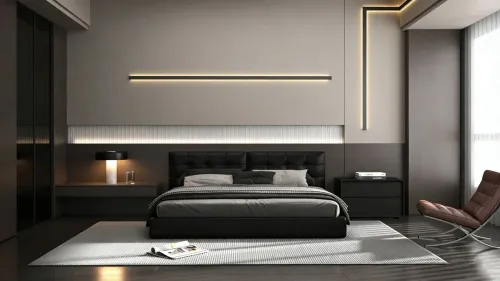
Living rooms and bedrooms where the ceiling-wall junction becomes a quiet architectural statement.
Restaurants & Bars
Layered corner glow sets mood lighting without competing with pendant or accent fixtures.
Corporate Reception & Boardrooms
A clean, glare-free perimeter line that reads as considered design rather than office lighting.
Retail & Showrooms
Frames the shop floor in soft light while spotlighting stays reserved for the product itself.
Banquet & Event Halls
Colour-programmable wall channel adapts the same corner line to different event themes.
Galleries & Museums
Ambient ceiling wash keeps background light even without a single visible downlight in view.
Spas & Wellness Centres
Two soft planes of indirect light instead of one, suited to spaces built around calm.
Frequently Asked Questions
Installation and specification questions about the NLP-6969
-
Most cove profiles carry a single LED channel and light in one direction only. The NLP-6969 is a corner profile with two separate channels built into one 69x69mm body — one channel faces the ceiling, the other faces the wall. A single fixing at the wall-ceiling corner produces two independent light lines instead of one, without needing two separate profiles or two installation points.
-
No. The NLP-6969 is designed as a surface-mounted corner profile — it fixes directly onto the existing wall-ceiling junction with screws or adhesive, and no plaster recess, false ceiling drop, or gypsum work is required. It can also be built into a plasterboard reveal for projects that want the profile body itself hidden, but this is optional, not necessary.
-
Yes. Each channel in the NLP-6969 is wired and controlled independently, so the upward channel can run a warm white 3000K strip for ceiling ambience while the downward channel runs a tunable white or RGBWW strip for wall accent colour. The two channels do not need to match — this is often used deliberately to layer two different lighting moods from one profile.
-
Yes, ceiling finish has a real effect. Light or white ceilings reflect the upward wash evenly and spread it across the room. Dark or textured ceilings absorb more light, which reduces spread and softens the glow. For rooms with darker ceilings, specifying a higher-output LED strip in the upper channel compensates for the reduced reflectance.
-
No, in either channel. The NLP-6969 body is engineered to fully baffle both LED strips at normal eye level and seated sightlines. What is visible is only the reflected light — a soft band on the ceiling from the upper channel and a soft band on the wall from the lower channel. The aluminium body and PC diffuser together prevent any direct view of the LEDs themselves.
-
A gap of roughly 150 to 300mm between the LED strip and the ceiling plane gives the most even wash — close enough to keep the light band tight to the corner, far enough for the light to spread before it reaches the ceiling surface. Because the NLP-6969 mounts directly at the wall-ceiling junction, this spacing is largely built into the profile geometry already; taller rooms can drop the profile slightly lower on the wall to extend the wash further.
Plan Your Corner Lighting Line
Talk to our team about LED strip pairing, driver sizing, and channel control options for the NLP-6969.