When the Slot Is the Constraint, Not the Design
Two millimetre-level problems the NLF-0410 was built to solve
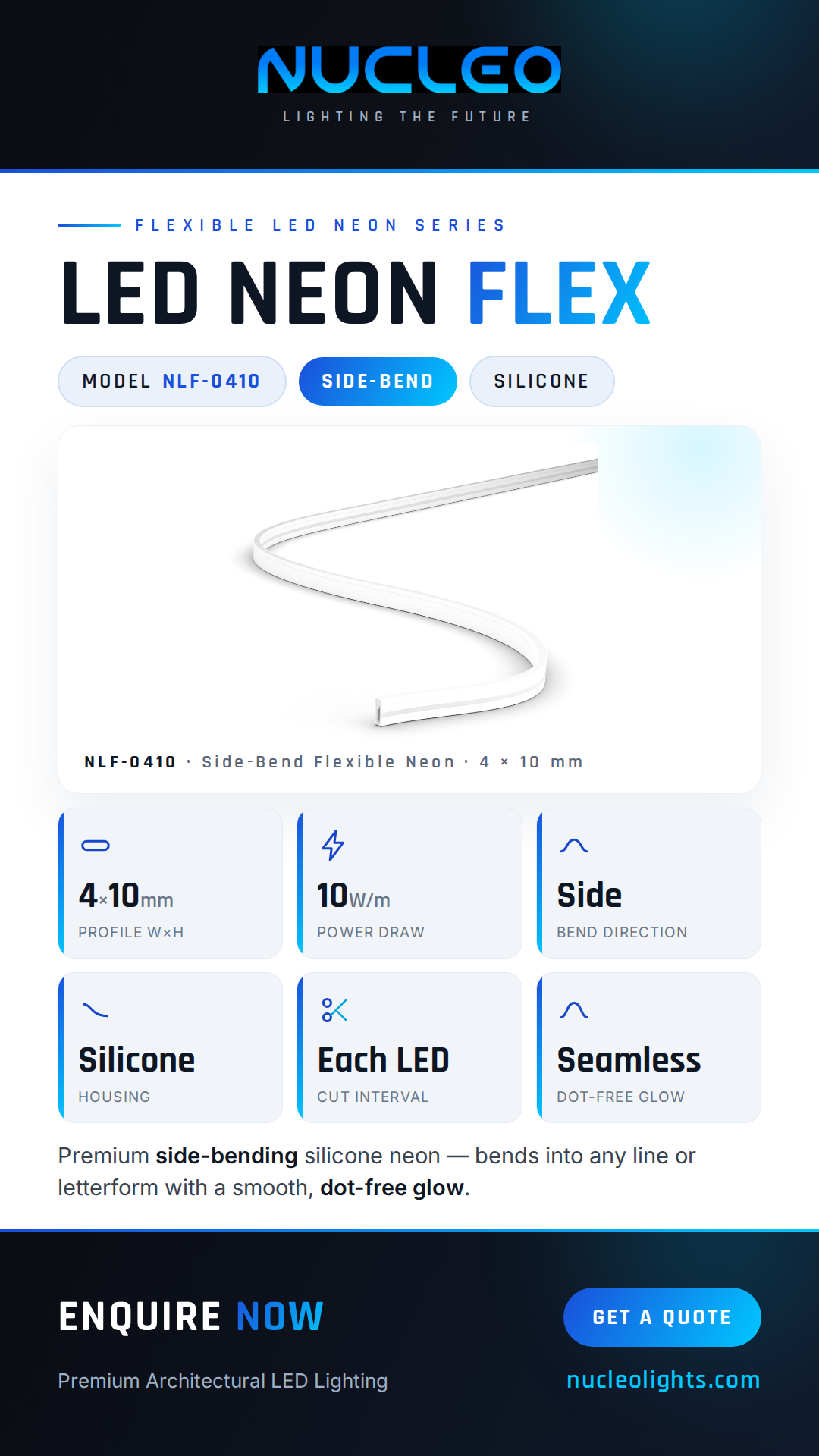
Furniture lighting usually fails at the measuring tape, not the design brief. A cabinet groove, a wardrobe aluminium channel, or a shelf edge slot is rarely wide enough for a standard 8-12mm LED strip or neon flex, and the length rarely lands on a clean 25 or 50mm cut mark either. The NLF-0410 is built to solve both problems at once: a body just 4mm wide by 10mm deep that slides into slots standard products can't enter, and a cut pitch of roughly 8.3mm — because with 120 LEDs packed into every metre, every single LED is a valid cut point.
The practical result is a strip that can be trimmed to within a few millimetres of the exact groove length instead of being rounded up, cut short, or routed to fit. At that LED density the light itself reads as a continuous line rather than individual dots, so the precision doesn't come at the cost of a smooth, seamless glow.
Colour Temperature
Two tones, matched to how the fitting is used
Warm White
3000K
Soft, incandescent-like tone for wardrobes, bedroom furniture, and display shelving.
Neutral White
4000K
Balanced, accurate white for kitchens and display cases where colour rendering matters.
Every LED Is a Cut Point
Conventional neon flex cuts every 25-50mm, which forces a compromise on either end of the run — a gap left over, or a length trimmed shorter than intended. At 120 LEDs per metre, the NLF-0410's LEDs sit roughly 8.3mm apart, and any point between two adjacent LEDs is a valid cut. A groove measured on site can be matched almost exactly rather than rounded to the nearest standard increment — the difference between a fitting that looks measured and one that looks approximated.
What the Numbers Mean on Site
Reading the spec sheet as installation outcomes
Fits 4mm Grooves
Standard furniture channels and cabinet edge slots are often 4-6mm — this profile enters them without routing or modification.
8.3mm Cut Precision
Every LED is a cut point, so lengths can be matched to the groove almost exactly instead of rounded to a standard increment.
No Visible Dots
120 LEDs per metre packs the light source densely enough that it reads as a smooth, unbroken line rather than individual points.
24V for Longer Runs
Holds brightness evenly across runs of a few metres from a single feed point, with less voltage drop than a 12V equivalent.
Silicone Body
Flexible and enclosed against dust and humidity — suited to the closed environment inside furniture and cabinetry.
Sensor Ready
Wires directly with 24V door switches, PIR sensors, and push-button triggers for automatic wardrobe and cabinet lighting.
Measure, Cut, Fit — In That Order
Because the cut pitch is so fine, the usual practice of rounding a length up "to be safe" isn't necessary — measure the groove, cut at the nearest LED, and the flex sits close to flush at both ends. It runs cooler than fluorescent or halogen cabinet lighting, so it's suited to enclosed wardrobe and cabinet cavities with only moderate air circulation.
Where It Fits
Slots and grooves standard strips and neon flex can't enter
Wardrobes
Interior edges, hanging rail channels, and shelf lips for a warm clothing-friendly glow.
Cabinets
Kitchen and living room cabinet grooves for clean, gapless edge lighting.
Shelving
Under-shelf channels in retail, libraries, and home shelving systems.
Mirror Frames
Slim channels behind bathroom and dressing mirrors for a halo edge glow.
Retail Display
Showcase and product shelf edges lit evenly without visible fixture bulk.
Kitchen Under-Shelf
Task lighting beneath wall units, fitted flush with no visible gaps.
Narrow Ceiling Reveals
Shadow-gap channels too tight for standard neon flex profiles.
Media Units
Behind TV panels and entertainment console edges for a discreet accent line.
Frequently Asked Questions
Specification and installation questions on the NLF-0410
-
With 120 LEDs packed into every metre, adjacent LEDs sit roughly 8.3mm apart, and the flex can be cut at any point between two LEDs. In practice this means a groove measured at, say, 743mm can be filled almost exactly, rather than rounded up or down to the nearest 25-50mm cut mark the way conventional neon flex requires.
-
Standard neon flex profiles typically run 8-16mm wide and cut every 25-50mm. The NLF-0410 is built specifically for tighter dimensions on both counts — a 4mm width that fits furniture grooves and cabinet channels standard neon flex cannot enter, and an 8.3mm cut pitch that lets the length be matched far more precisely to the actual slot.
-
24V holds brightness more consistently over longer continuous runs before voltage drop causes visible dimming toward the far end — relevant for wardrobe or cabinet runs of two to three metres fed from a single point. It also runs cooler, which matters inside an enclosed furniture cavity with limited airflow.
-
It runs noticeably cooler than fluorescent or halogen cabinet lighting. The silicone body dissipates heat gently along its length, and in typical wardrobe or cabinet use the flex stays warm to the touch rather than hot. Some air circulation within the cavity is still recommended for enclosed, low-ventilation furniture.
-
Yes. Running at 24V DC, it is compatible with 24V door-activated switches, PIR motion sensors, and standard push-button or magnetic reed switches. Wire the switch into the 24V feed ahead of the neon flex and it will activate automatically on door opening.
-
The NLF-0410 is available in warm white (3000K) and neutral white (4000K). Warm white is the common choice for wardrobes and bedroom furniture for its soft, incandescent-like tone. Neutral white is typically specified for kitchens and display shelving where colour accuracy of the contents matters more than ambience.
Order the NLF-0410 for Your Project
Talk to our team about groove measurements, colour temperature, driver sizing, and sensor wiring for your furniture lighting.