The Detail That Changes a Room
A shadow gap is one of the most refined details in contemporary interior architecture — a thin, precisely-formed recess at the junction between two surfaces that replaces a standard plastered corner with a clean dark line. The effect is immediate: surfaces appear to separate, to float, to belong to a more deliberate design. The XF5 is the aluminium profile that makes this detail buildable, repeatable, and precise.
The XF5 installs at wall-ceiling junctions, panel joints, staircase reveals, and any surface transition where a shadow line is part of the design language. Its internal channel accepts a standard LED strip — so the same profile that creates the architectural shadow detail by day becomes a source of soft, indirect ambient light when the strip is powered on. One profile. Two effects.
Shadow Line by Day. Ambient Glow by Night.
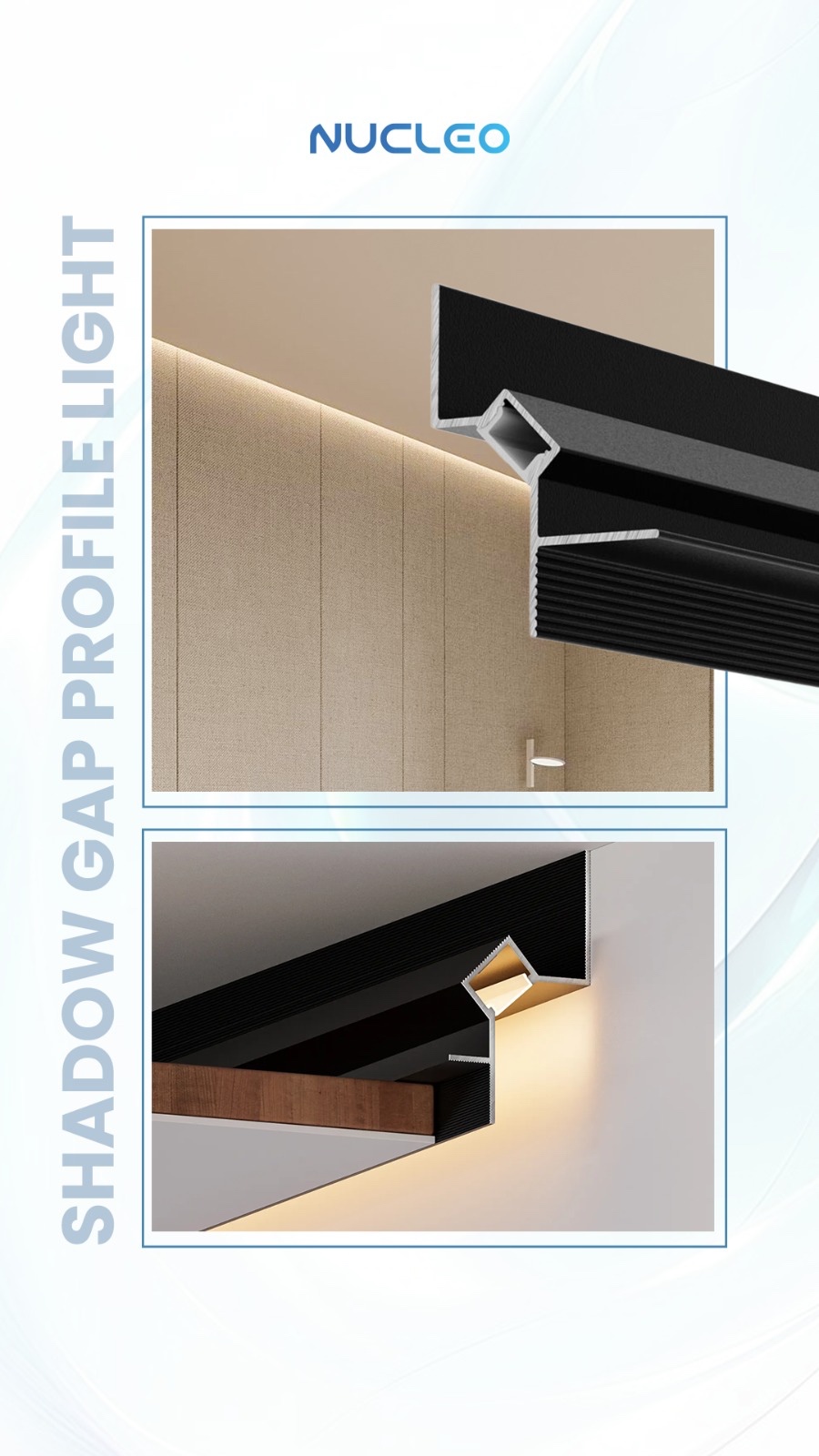
In cross-section, the XF5 presents a clean recessed slot at the surface junction — deep enough to read as a shadow, precise enough to require no paint touch-up or bead treatment at the corner.
The LED strip sits in the internal channel at the base of the slot. When lit, it washes the adjacent ceiling or wall with indirect light — the source is completely hidden within the recess. No visible fixture, no exposed strip, no harsh point of brightness. Only a soft, sourceless glow radiating from the line.
Two Modes, One Profile
Without a LED strip, the XF5 creates a clean, sharp dark recess at the junction. The shadow line reads as a deliberate architectural gap — surfaces appear separated and floating. No lighting required; the detail is purely visual and geometric.
With a LED strip inside the channel, the shadow gap becomes a light source — indirect, ambient, and completely concealed. The ceiling above or wall beside washes with soft light. The profile itself remains a dark shadow line; the light appears sourceless.
The Floating Ceiling Effect
At the wall-ceiling junction, the XF5 shadow gap produces the most widely specified effect in contemporary residential and hospitality interiors: the floating ceiling. The ceiling panel appears to hover above the wall — separated by a dark recessed line — rather than meeting it at a hard plastered corner. With the LED strip on, indirect light radiates upward from within the gap, washing the ceiling with ambient light that appears to have no source. The result is a ceiling that seems to float above a line of light. This effect cannot be achieved with a surface-mount profile or a corniced finish — it requires a plaster-in shadow gap profile like the XF5.
Where the XF5 Installs
Wall–Ceiling Junction
Run horizontally around the perimeter of a room — creates the floating ceiling effect with optional indirect uplight on the ceiling surface.
Wall Panel Joints
Between cladding panels, timber boards, or stone slabs — the shadow gap replaces a visible joint with a designed recessed line.
Feature Wall Lines
Vertical shadow lines on feature walls or TV backdrops — creates rhythm and depth on a flat surface without applied moulding.
Stringer & Riser Lines
Along staircase stringers or risers — a shadow line that runs the full height of a stair wall, with optional LED glow along the flight.
Floor–Wall Transition
At the skirting line — the shadow gap replaces a traditional skirting board with a clean recessed reveal at floor level.
Door & Window Reveals
Around door frames and window openings — a consistent shadow line that frames the opening without applied architrave.
Plaster-In Installation — Set and Forget
The XF5 is fixed to the substrate — masonry, timber studwork, or GRG bead — before plastering or boarding. The flanges sit flush with the wall and ceiling surface, and plaster or jointing compound is applied up to the profile edge. Once set, the aluminium body forms the permanent shadow gap recess — dimensionally stable, crack-resistant, and paint-ready. The LED strip is inserted into the internal channel after the finishing work is complete, protecting the strip from dust and debris during construction. The finished detail requires no paint treatment at the corners and no ongoing maintenance.
Key Features
Precise Shadow Line
The XF5 creates a dimensionally consistent shadow gap along the full run — no variation in depth or width, no paint touch-up at the corner, no cracking over time.
Internal LED Channel
The channel inside the profile accepts a standard LED strip. The strip is fully concealed within the recess — no exposed source, no visible hardware, only indirect light.
Plaster-In Flanges
The profile flanges are embedded into the plaster or board finish. The result is a flush, clean junction with no visible screw heads, no applied beads, and no reveal gap.
Horizontal or Vertical
The XF5 runs in any direction — horizontal at the ceiling line, vertical on feature walls, diagonal on staircase stringers, or along any straight surface transition.
Aluminium Extrusion
Anodised aluminium profile — dimensionally stable, corrosion-resistant, and compatible with plaster, gypboard, cement render, and lime finish.
On-Site Cuttable
The aluminium extrusion cuts cleanly with a mitre saw or angle grinder — custom lengths for any room dimension, mitre joints for internal and external corners.
Applications
Residential Interiors
Living rooms, bedrooms, and dining spaces — floating ceiling effect and ambient cove lighting
Hotels & Resorts
Guest rooms, lobbies, and corridors — refined shadow line as a signature architectural detail
Restaurants & Bars
Ceiling perimeter lighting and wall panel joint detailing — layers ambience without visible fixtures
Commercial Offices
Reception areas, boardrooms, and breakout spaces — architectural ceiling detail without a traditional cornice
Feature Walls
Vertical or horizontal shadow lines on TV walls, headboards, and entrance walls
Staircase & Landings
Shadow line along stair stringers with LED strip for continuous staircase accent lighting
Hospitality Fit-Outs
Spas, salons, and wellness spaces — shadow gap details in gyp board and stone cladding
Retail & Showrooms
Clean ceiling lines and wall panel details in premium retail environments
Frequently Asked Questions
Add the Shadow Gap Detail to Your Project
Contact Nucleo for the XF5 Shadow Gap Aluminium Profile — dimensions, samples, and technical support available pan-India.